
News
Research highlights from ISMRM 2026
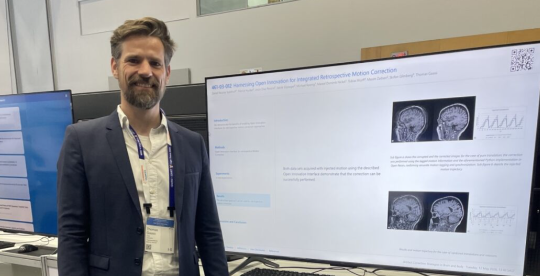
Learn about the newest Tracoline-led research, which featured at this year’s conference in Cape Town.
First-ever Tracoline-led prospective motion correction study in sleeping infants!
For the first time, researchers have quantified the impact of active motion correction in infants aged 3–12 months – a population where sedation-free imaging has long been a major unsolved challenge. Using Tracoline for real-time motion updates, the results were striking: significantly sharper T2w images, improved gray/white matter contrast, and meaningfully reduced overestimation of cortical thickness – especially in the frontal and occipital lobes. The verdict? Prospective motion correction isn’t just beneficial in sleeping infants. It’s essential.
Tracoline’s motion updates for retrospective motion correction can be intergated directly into the reconstruction pipeline via advances in Siemens’ Open Innovation technology.
Siemens Healthineers showed how Tracoline’s motion data can feed directly into open reconstruction pipelines, enabling full rigid body retrospective correction of MPRAGE brain scans within the Siemens Open Recon framework. This is a major step toward empowering the MRI community overall with fast RMC at their fingertips.
From the tiniest patients to next-generation reconstruction infrastructure – these two abstracts together paint an exciting picture of where Tracoline-led motion tracking and motion correction in brain MRI is headed.